

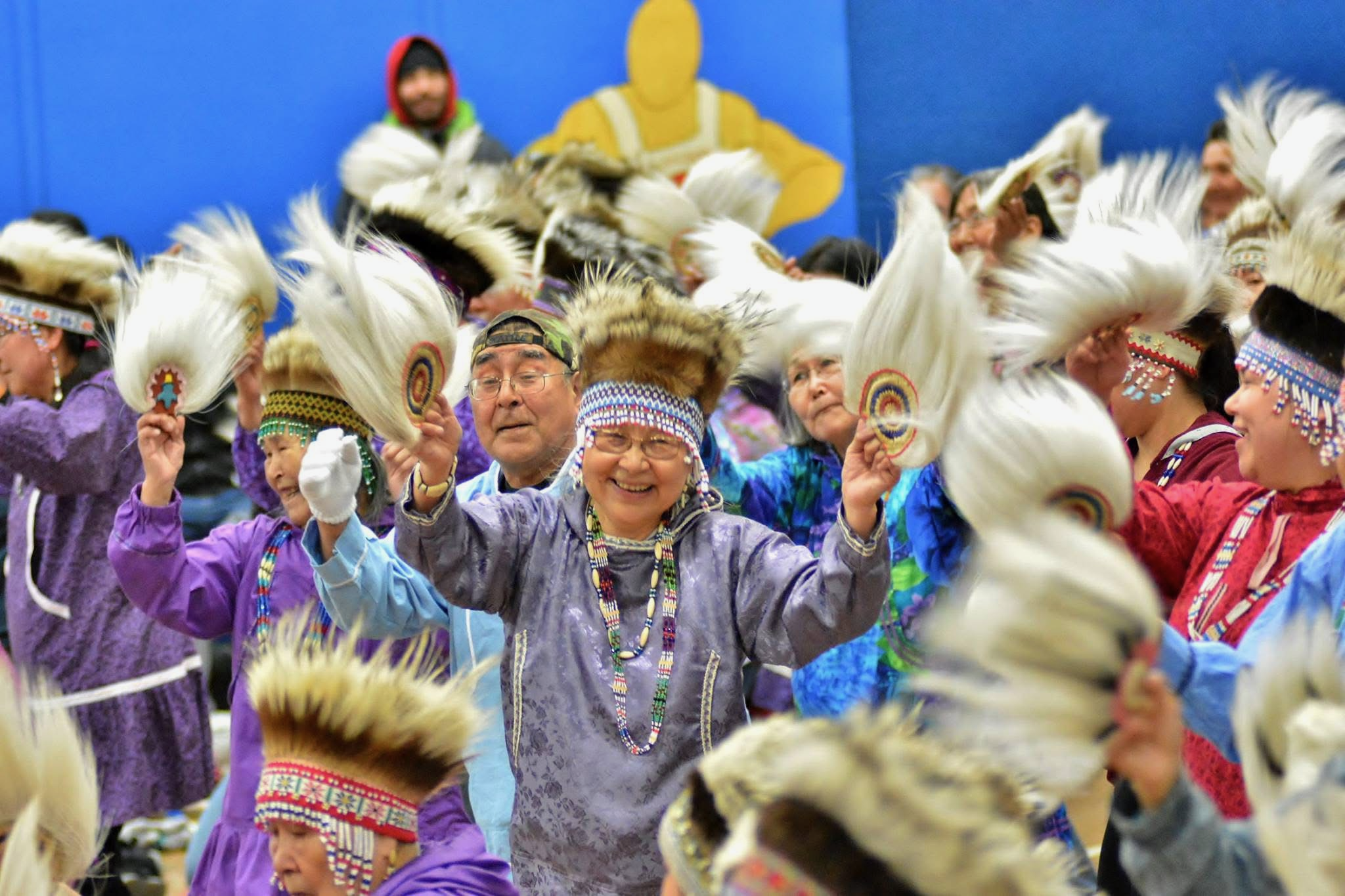
Dr. Arevgaq Theresa John is this year’s Living Treasure
Photo by Jimmie Lincoln
Background
Arevgaq is from Nunakauyaq on Qaluyaat, Toksook Bay on Nelson Island. She was born to the late Chief Dr. Paul Kangrilnguq John and Martina John and grew up in the traditional Yup’ik lifestyle of subsistence and ceremonial yuraq practices.
Through her early childhood experiences, she learned from precontact elders, people who were alive before Alaska became colonized by Russians and Americans. We are incredibly fortunate to benefit from the extensive work that Arevgaq contributed to the world of Indigenous and Yup’ik education.
Legacy Work
Arevgaq began teaching at the University of Alaska Fairbanks in 1985 and has contributed to numerous publications, films, and shared from her vast knowledge at many conferences and gatherings. In 2011, she was appointed to serve as a member on the National Advisory Council on Indian Education under President Barack Obama.
Throughout her professional career, she has taught 28 course subjects to generations of eager learners, imparting her wisdom to ensure that future generations will retain and continue to practice our culture.
Arevgaq’s doctorate dissertation, published in 2010, “Yuraryaraput Kangiit-llu: Our Ways of Dance and Their Meanings has helped to document the integral role of yuraq in the Yup’ik culture. Thanks to the internet, people everywhere can now access videos of Arevgaq delivering insights into the world of yuraq. The Sealaska Heritage Institute published one such video:
Personal life
The John family includes many professional educators and community, statewide, and national leaders who help to shape and preserve governance practices in our tribal communities. Arevgaq and her siblings encourage their family to continue to speak in Yugtun at home. Their children and grandchildren continue to participate and lead in local yuraq groups, ensuring that future generations will continue to dance and sing our traditions.
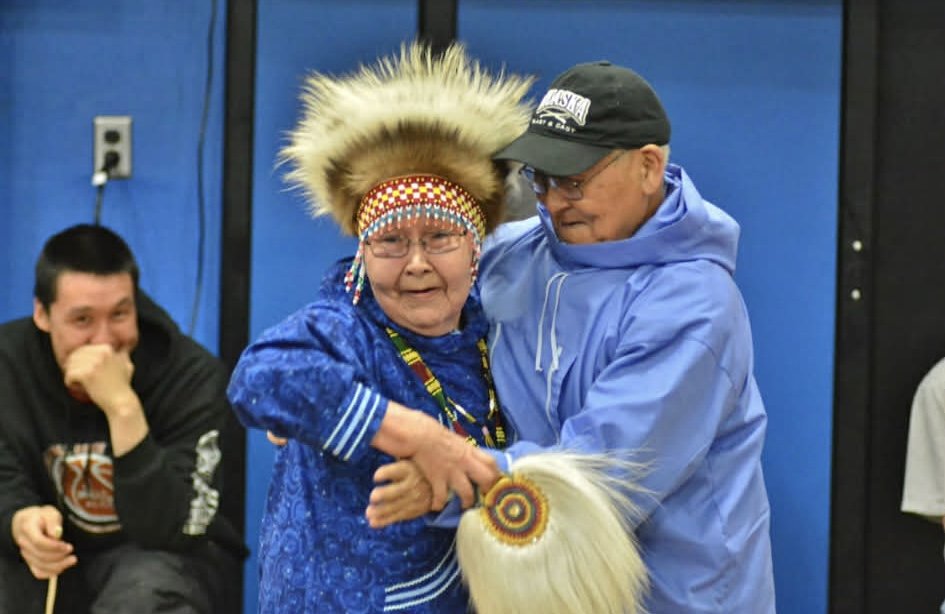
The 2026 Cama’i Dance Festival is Dedicated to Paniliar Theresa Abraham
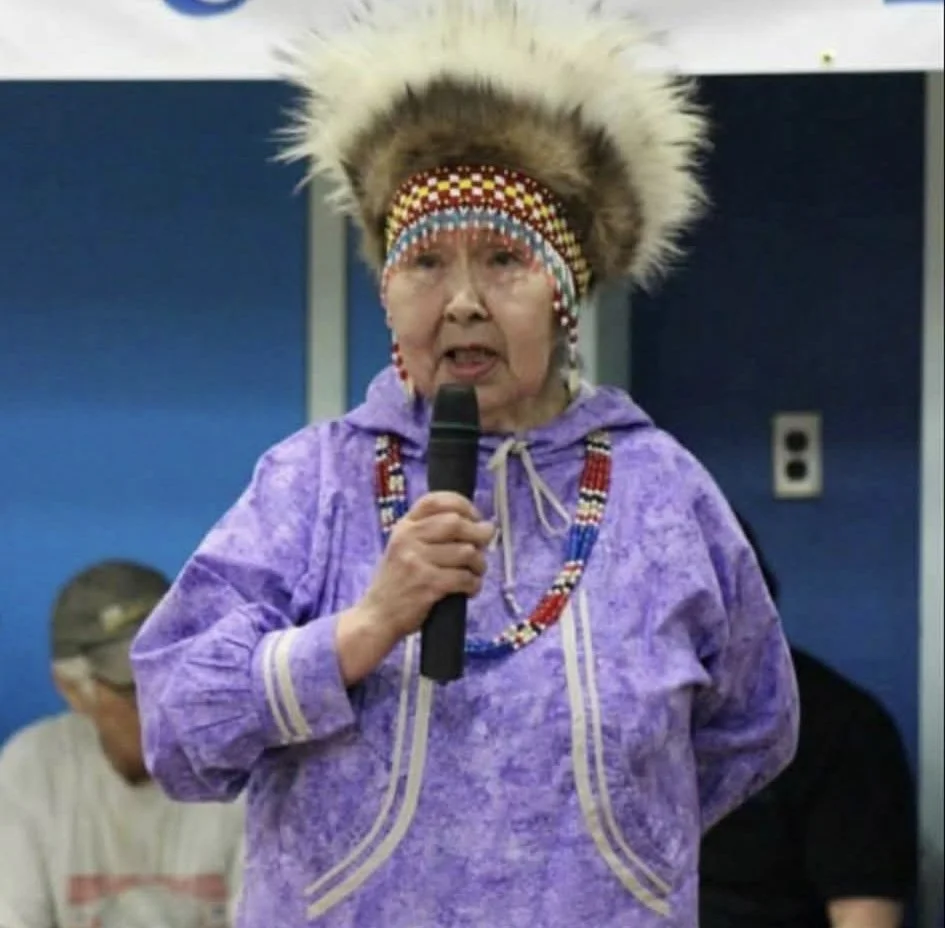
Paniliar Theresa Abraham
April 9, 1941 - September 11, 2021
It is customary for the Cama’i Dance Festival to dedicate the event to at least one inspiring individual whose legacy helped to shape and preserve our cultural traditions in the delta. The Cama’i Dance Festival is deeply honored to recognize the contributions of Paniliar Theresa Abraham of Chefornak and dedicates this year’s event to her memory.
Background
Paniliar was born and raised in the village of Caputnguaq, near the coast of southwest Alaska. Many residents of this community, including Paniliar relocated to the village of Chefornak when Alaska became an American territory. In Chefornak, she and her husband Jobe raised nine children.
Legacy work
Paniliar always made herself available to pass down Yup’ik cultural knowledge, whether it was by assisting with hands-on activities, through recorded interviews or sharing her vast knowledge at public events. Paniliar’s contributions of Indigenous knowledge were incorporated into many Calista Education & Culture, Inc. publications like All the Land’s Surface is Medicine, The Flying Parka, and Our Yup’ik World & Weather, ensuring the preservation of our Yup’ik culture for future generations.
Umkumiut, a village on Qaluyaat (Nelson Island) hosts many cultural camps attended by Yup’ik people of all ages, from youth to elders who all process fish following their seasonal availability. It’s here that Paniliar participated, skillfully showing the younger generation how to process and preserve food that will sustain us through the winter. She believed strongly in starting children young, giving them tools to practice aspects of food preservation and adapting with the child’s capabilities.
In her community, she was a patient teacher of yuraq. Many who knew her describe her as calm and playful– using humor to engage with those around her. Many will attribute the role of “leader” to a male drummer, but it’s usually the women who they rely on to remember carefully choreographed movements and lyrics for the stories the dances tell.
Personal life
Those who knew Paniliar best describe her as warm, attentive, resourceful and hospitable. In the Yup’ik culture, men often assume the role of hunter and provider, braving the elements to ensure their families have enough food and wood for heat. Their success often depends on the quality of their tools and gear. Paniliar expertly crafted fur clothing for her family, including atkuks, piluguqs, mittens and more.
Her handiwork, including intricately woven grass baskets, also supplemented her family’s income to be able to afford fuel for subsistence activities and for the purchase of essential equipment. Through her life, she showed us what pingnatugyaraq, striving for Yup’ik excellence, truly means.
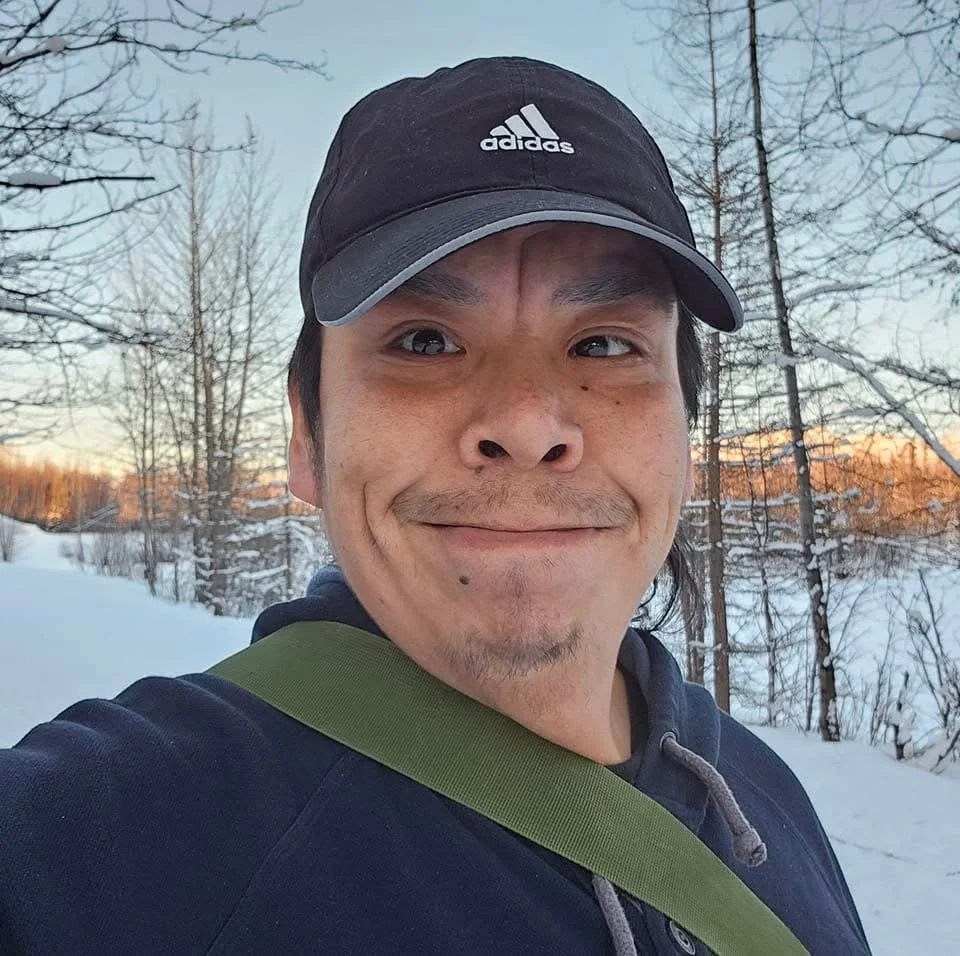
The 2026 Cama’i Dance Festival Honors Alexie Callerkuaq Anvil
In 2006, Alexie Callerkuaq Anvil began volunteering for the Cama’i Dance Festival as a school usher at age twenty. In 2015, he stepped into the role of team lead for the school ushers. He’s been in this role ever since, directing volunteers and festival-goers alike to help keep the festival safe for all attendees. Alexie began attending the Cama’i Dance Festival long before he began volunteering. In fact, he’s attended Cama’i in practically every role: as a dancer with his school, as an audience member, and for the last 19 years as an integral part of the volunteer team.
In his earliest memories of the festival, he recalls performances from dance groups that came to Bethel from all over the world, including from the lower 48, Japan, and China. At the festival, Alexie’s favorite moment is the Heart of the Drums, when drummers from all performing groups gather to beat their cauyaq in time with one another, starting low and slowly growing to a beat so loud, strong, and singular that you can feel it in your body and in the shake of the gymnasium floor.
“Once the drummers from all the groups come together and drum, you can feel the warmth, the happiness,” described Alexie. “It helps rejoice the body, and the mind and spirit.”
He also remembers watching the late Maryann Sundown of Scammon Bay perform dances like the mosquito dance. He says that the Cama’i Dance Festival serves as an important spiritual reminder of Elders and their wisdom: “That helps me keep going. I think of loved ones, the spirit life. You can feel it–their spirits, watching, going around. The high school is like a holy place for dancing.”
Being at the festival is like going back in time for Alexie, as he thinks of all the people who have been attending Cama’i for forty years. Being the team lead for the ushers offers its own special glimpse into the past too, as Alexie remembers being a kid running around Bethel Regional High School, being told to slow down and stop running.
“It reminds me of myself when I was that small, being mischievous,” he remembers. Now, Alexie is on the other side of that equation, stepping into the role of the adult who tells kids to stop running.
Above all, Alexie says, his top priority in volunteering for the festival is to provide a sense of safety. He thinks of everyone, from children to parents to Elders, and how he can best look out for all attendees as much as possible. It’s why he’s come back to the festival as a volunteer for twenty years, even when the work is hard. To him, the festival gathers joy, warmth, and connection under one roof, and his dedication to the festival contributes to that. It is with gratitude for this that the Cama’i Dance Festival is pleased to award Alexie Callerkuaq Anvil with Cama’i Honors at this year’s festival.
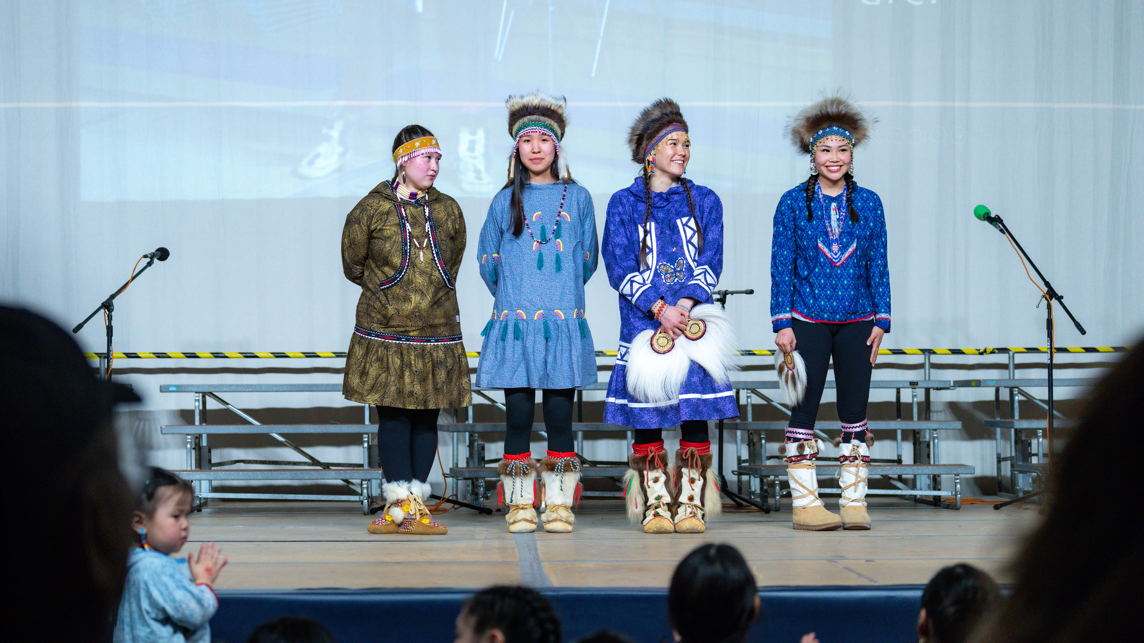
Thirty-two years later, the legacy of Miss Cama’i lives on.
The contestants of the 2025 Miss Cama’i Pageant stand onstage.
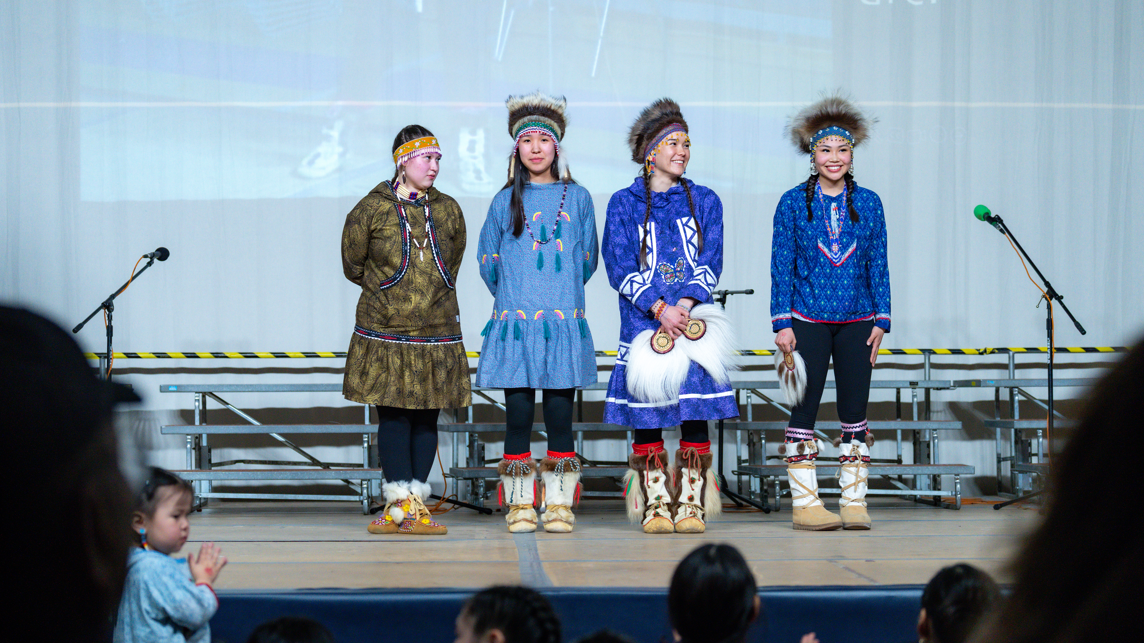
The contestants in the 2025 Miss Cama’i Pageant stand onstage.
Each year, the Cama’i Dance Festival recognizes the accomplishments of young Alaska Native women in the Miss Cama’i Pageant. The pageant, originally founded in 1994, crowns a young woman to serve as a cultural ambassador whose mission is to build leadership and increase community involvement among people of the Y-K Delta and beyond. Over the years, the legacy of the Miss Cama’i pageant has grown alongside the long line of women who have worn the crown and passed it on, including Kelsey Ciugun Wallace, who, though never officially crowned Miss Cama’i, played a key role in leading the pageant in the 2010s.
In 2011, Wallace was crowned Bethel’s Miss Kuskokwim, a pageant that took place at Bethel’s Fourth of July celebration in front of the old bowling alley. From there, she went on to compete in and win the Miss WEIO (World Eskimo Indian Olympics) Pageant just a few weeks later. Upon her return to Bethel, Wallace was inspired to restructure the Miss Cama’i pageant. She and her father John worked to organize and coordinate the pageant with the support of numerous local organizations and volunteers.
Wallace cites the Miss WEIO pageant as an important source of inspiration for the current structure of Miss Cama’i: “We tried to model a couple of key elements from Miss WEIO’s competition. The little orientation and the interview, and then we added on the photo shoot.”
For Wallace, the Miss Cama’i pageant meant creating opportunities for young women to be role models in their communities.
“Being able to see someone who, you know, puts their best foot forward and who wants to be healthy and wants to be a good person in our community,” is what it’s all about, says Wallace. “I think that is really healthy for our communities.”
Where traditional beauty pageants judge contestants on things like swimsuits or hairstyles, Wallace says, the Miss Cama’i pageant’s status as a cultural pageant makes it stand out.
“When it comes to cultural pageants like Miss Cama’i, you have a chance to share about your culture and who you are in your place and your culture, and that is where it becomes so special,” she said. “It’s not a beauty pageant, it’s really a cultural pageant where these women are able to bring forward the beauty and the strength and the support of community”
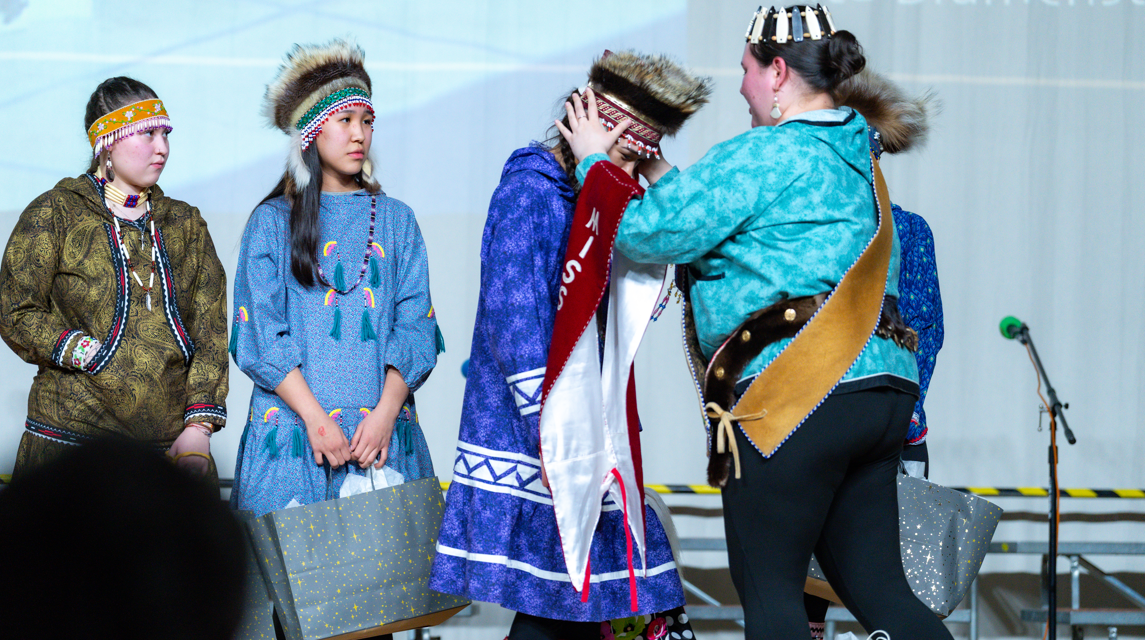
Tatiana Taanka Korthuis crowns Joeli Angukarnaq Carlson as 2025’s Miss Cama’i.
Now, thirty-two years after the original pageant, the legacy of Miss Cama’i continues to grow. Among the ranks of those who have worn the crown are Tatiana Taanka Korthuis and Joeli Angukarnaq Carlson, the two most recent Y-K Delta women to be crowned Miss Cama’i in 2024 and 2025 respectively. Both also continued on to be crowned Miss WEIO in the months succeeding the festival, an accomplishment held by several Miss Cama’i winners over the years.
Korthuis and Carlson, who both attended Bethel’s Yup’ik immersion school Ayaprun Elitnaurvik, have fond memories of dancing at and attending the Cama’i Dance Festival as children.
“Each year I remember being so excited about watching Miss Cama’i,” Korthuis reminisced. “As a little girl, I’d be rooting for her. As I’ve gotten older, I was kind of like ‘Okay, she knows what she’s doing!’ So I’d look up to these women who were up there running for Miss Cama’i. From a young age, I knew without knowing that I wanted to run for Miss Cama’i one day.”
Carlson, who is from Kwethluk and Bethel, remembers watching the pageants, too, but never imagined that she herself would be onstage wearing the crown one day. When the day came for her to compete for the title of Miss Cama’i, Carlson’s focus was on increasing representation of those with mixed heritage like herself.
“I feel like our generation is one of the first generations that's mixed and, you know, they don't really see that representation of us,” she said. “I didn't really see anything like that growing up.”
Onstage, Carlson’s platform of walking gracefully in both the Western and Native worlds resonated with the many people whose lived experience reflects both Native and non-Native roots. She recalls feeling shy at her first public appearance as Miss Cama’i during 2025’s Breakup Bash in Bethel.
“It was really cold out, and windy, so I had my qaspeq on, and then I had a hat on, and I had my coat over the sash,” Carlson said. She remembers being approached by a woman whose name she didn’t know, but who told her she had once been Miss Cama’i, too. “She fixed my sash and everything. She was like, ‘I was Miss Cama’i. You have to show your sash proudly and not be so shy.’”
In this simple act of encouragement, Carlson was reminded of the legacy that she is now a part of in bearing the Miss Cama’i title. She’s excited to continue carrying it on, to tell her story, and to represent the people of the Y-K Delta.
For both Korthuis and Carlson, the experience of being Miss Cama’i has opened doors and forged new connections.
“I've had the opportunity to travel, to connect with people from different backgrounds and really represent my story and represent our communities,” Korthuis said. “I think that was my favorite part, was meeting new people, and being able to connect with them about who we are, especially as Indigenous people.”
As preparations for this year’s Cama’i Dance Festival are underway, and with them the preparations for a new Miss Cama’i to be crowned, Korthuis and Carlson want to encourage everyone who has even the slightest desire to apply for the pageant to do it. Their advice? Be yourself, and know that you are the one who knows your story best.
Applications for this year’s Miss Cama’i pageant are now open! Visit swaagak.org/miss-camai for more information and to access the application.